
Jan 21, 2026
Q: I heard something on the radio about Amazon building a robot to help them decide who to hire but the robot was sexist or something and now I’m confused. What’s going on?
A: What is up with all this advanced technology being racist and sexist all the time?! Dark skin not triggering automatic bathroom soap dispensers (bit.ly/2EGvngP)? Facial recognition software telling Asians to open their eyes for their passport photos (https://reut.rs/2S8NheC)? Shouldn’t tech be smarter than that? It’s an old problem that boils down to new technology not being tested on minority populations and it goes back at least to the invention of scissors for only right-handed folk.
You’re probably referring to the story “Amazon scraps secret AI recruiting tool that showed bias against women,” reported by Reuters at https://reut.rs/2D1MeJg. It wasn’t a robot—it was a computer program meant to help guide hiring decisions. And it wasn’t sexist; it was just responding to the input it was given. That’s what computers do, often to the chagrin of users and programmers alike.
Such stories have become increasingly common as big tech companies have tried to automate decisions that once fell to lowly humans. After all, if Alexa can understand speech well enough to turn off the lights, shouldn’t her cousins be able to sift through some résumés? One of the hopes for Artificial Intelligence was that it might make decisions based on pure data and rigorous math without succumbing to prejudices like people do.
What went wrong? One of the first lessons of programming is GIGO—“garbage in, garbage out.” It doesn’t matter how great your program is: bad inputs lead to bad outputs.
The type of AI used here is called Machine Learning (ML), because it mimics how humans learn. Consider how kids learn to distinguish cats from dogs. They don’t memorize a set of rules to apply whenever they see an animal. Instead, their parents point to Fido and say “dog,” or tell them to “pet the cat” when Whiskers saunters by.
Different neurons are activated when they see different animals, and eventually their brains associate certain patterns of neurons firing with cats and others with dogs. At that point, they have learned the difference.
Programmers simulate this brain behavior with a program called a neural network. These are trained by showing them thousands of labeled cat and dog pictures. Then they are tested when asked to categorize a new picture not seen before. If their training was successful—if they determined the patterns that differentiate a dog from a cat—they will correctly identify new pictures without human intervention.
This technology is powerful: it gave us Alexa, Siri, and Google Assistant. But because of GIGO, it also gave Amazon a “sexist” HR assistant. The quotes are because the program doesn’t really know about men and women—it only knows about inputs and outputs. Since it was trained with résumés that Amazon had accepted and rejected, it learned that Amazon didn’t hire many candidates who graduated from majority-women colleges or listed certain hobbies (softball, maybe, or ballet). Amazon did not provide details, but they did cancel the program.
It turns out that feeding biased data into a program designed to look for patterns causes it to learn the biases and then mimic them. GIGO.
The problem is not new. In 2016, ProPublica claimed to find it in software that predicts recidivism rates for criminal offenders (bit.ly/2JgDqzC). That same year, Microsoft had to shutter an AI-powered Twitter chatbot after twenty-four hours because it quickly learned to imitate homophobic slurs (https://for.tn/2D1M4Bo).
Even when the results aren’t disastrous, they can be just…weird. Witness Burger King’s advertising speak created by similar programs: bit.ly/2EFV1SL. Or check out a whole site dedicated to AI weirdness: aiweirdness.com.
What’s the solution? Feeding in unbiased data certainly helps, as does removing irrelevant data points. Some researchers report success with a statistical trick called oversampling—giving their programs three copies of each résumé from a woman, for example, so the program doesn’t notice a discrepancy in previous hiring practices.
We think the problems will persist until someone invents Artificial Judgment (AJ), to coin a term, to go along with AI. We’ll get on that right away, as soon as we extract this left-handed mouse from its packaging with our new left-handed scissors.

Jan 21, 2026
Q: Well, the turkey is gone. Time to get up and get some shopping done, right?
A: Yeah…I am about napped out. I better get going.
I did make some progress this weekend. I was surprised to encounter some friendly elves delivering a Christmas tree to my building. I did some inquiring. A few clicks later and I am happy to report that treeelves.net is scheduled to bring a fresh Fraser fir to my house next week. The tree comes already on the stand and they will pick it up after the holidays all for a little over $100. My elves cover Atlanta, Charlotte, Greenville, Nashville and Richmond, but I suspect you can find a similar service in your area. I figure that earned me another nap.
Time to speak up! With the advent of Amazon Echo and Google Home, the smart speaker is everywhere. Still, some are not thrilled with the sound or other features and are looking for an upgrade. Sonos.com has the Sonos One at under $200 and Beam at $350. So, before you buy another Echo (amazon.com/echo) or Home (google.com/home), do some shopping.
Are you still reaching around the cord to turn off the lights? C’mon really? The son of the Clapper, the smart plug invasion has begun. At about $30 (wemo.com) there are dozens of choices, all pretty much the same. You plug them in, do some tedious syncing with Echo or Home, then say “Alexa, turn the den lights on.”
Most of the entrants come with an app, but after set-up, most likely Google or Amazon can handle what you need including scheduling, naming, and grouping your switches. These are not for all of your lamps. If your people are used to using the lamp switch, these can be annoying. So, a few go a long way to making your home a bit smarter.
Knock knock. Are you asleep? Smart video doorbells are not new, but if you don’t have one, you will probably get one for Christmas. At around $100 to $200, Ring (ring.com) and Blink (blinkforhome.com) lead the pack with many others to choose from. They either run on batteries or are wired to your existing doorbell circuit.
These oversized doorbells wake up when they detect motion. They ring (of course), but also buzz your phone or wake up Alexa where you can see and talk to your visitor or intruder and can record the event if you are busy napping.
Looking for a stocking stuffer? Buy your clan wireless charging pads. My first one 2 years ago cost me about $70 and changed my life. I mean I have to put my phone down when I am snoozing anyway. Now they are around $20 so you can afford to have them all around the house. Best bet…look at Amazon’s collection.
OK, no personal experience here…my blow-drying days are behind me. But consider the Dyson Airwrap (dyson.com) at $500 for your loved one. The videos sold me. This latest hi-tech gadget from that weird British inventor might be the personal gift you were looking for. Apparently, it is a blow dryer, curler, and straightener. Not sure what all that means, but I think it is good.
Trouble finding something for the nephew or grandson? I bought a Nintendo Labo kit (labo.nintendo.com). These are kits that extend the capability of the Nintendo Switch. You put together these high quality, durable cardboard extensions/holders for the switch controllers that act as peddles, joysticks, steering wheels and the like that interact with video games. These run about $80 and include robot, piano, vehicle and other configurations.
Ok, you still have time before you review your 2018 New Year’s resolutions. But, number one was to stop storing your passwords in a note on your phone. So, check out dashlane.com before the year runs out. Multi-device plans start at free, but at $10 a month you get advanced features like VPN protected Wi-Fi, encrypted document storage, dark web monitoring, credit protections, and identity theft insurance. This is a two-fer. One for you, one for Dad. Both of you will sleep easier.
Now it really is time for a nap. Have a great holiday.

Jan 21, 2026
Q: The Consumer Electronics Show came and went a month ago and I’m still waiting for the PropellerHead take on all the exciting new technology they announced – what gives?
A: We just assumed that some sort of AI chatbot was going to write this column for us, but since that hasn’t come to pass – yet – we’ll have to do it ourselves. Still, if the 2019 CES was any indication, Amazon or Google will end up sticking Alexa or Google Assistant somewhere in this write-up before we get to the end of it.
For any of our readers who’ve just learned about electricity since Christmas: The Consumer Electronics Show (CES) is the annual Las Vegas convocation where big-name tech companies introduce the latest gear, gadgets, and gewgaws that we’ll consign to our attics in twenty years after they enjoy a brief layover in our daily lives as The Next Big Thing We Don’t Know How We Ever Lived Without. If that sounds overly dramatic, consider past hits: VCRs (1970), camcorders (1981), DVDs (1996), and HDTVs (1998).
If CES is nothing else, it’s the place to see huge TVs, and lots of ‘em. There’s your 98-inch 8K set from Samsung (cnet.co/2WSnoSS) and your 75-inch MicroLED “modular” TV, also from Samsung (bit.ly/2GbgdA0) – this one is made up of panels that you can re-arrange into different shapes. LG’s Signature OLED TV R rolls up into its base when not in use (bit.ly/2GsCcS7) like a glowing square armadillo, if those had Alexa and Google Assistant integration.
If you’re a gamer and price is no obstacle, HP introduced a 65-inch 4K UHD monitor for $5000 (bit.ly/2RHKKGP). Steep, sure, but gamers gotta game, right? At half the size and a tenth the price, Samsung’s Space monitor sports slim bezels, a space-saving clamp, and built-in cable management (bit.ly/2Tyttlj).
Several companies launched new smart watches at the show this year (bit.ly/2BmE9w2), from Kate Spade’s stylish Scallop 2 to Withings’ Move ECG (as in electrocardiogram). Sphero introduced Specdrums, “smart rings” that detect what color item you’re tapping your finger on and play different sounds that you customize with their app (sphero.com/specdrums). Embr Labs demonstrated the Wave, a bracelet that warms or cools the “thermally sensitive skin” of your wrist to simulate the chill of an ice cube or “the comforting warmth of a hot drink” (embrlabs.com).
But all the real, smart fun is in the real, smart home of the future. Smart mirrors from various companies recommend clothes for your body type (“Tap here to shop muumuus” – probably my new mirror), display the news and your schedule for the day (thanks to Google Assistant integration), or preview different hair and make-up options using augmented reality. See bit.ly/2SgzGG5 for which company makes which of these mirrors.
But a home is not a smart home without a clever loo, and that’s where the Kohler Intelligent Toilet comes in (bit.ly/2TxrDkE). With Alexa integration (really), “adjustable water temperature, pressure, and spray,” a heated seat, ambient lighting, an automatic deodorizer, an automatic lid, and speakers with wireless streaming, this promises to be the smartest thing you’ve pooped on since that scathing review of Rushmore you wrote for the high school newspaper.
Maybe it’s your cat that needs an iPotty? Check out the LavvieBot (lavviebot.com), a self-cleaning litter box that beams your cat’s weight and, um, “business schedule” to the included “PurrSong” smartphone crapplication. Need to know if Mr. Whiskers BMs in the PMs? Kohler can’t help you there! Who’s the smart can meow?! Bye-bye, “there’s an app for that” – hello, “there’s a crap for cat!”
If a cat is exactly the opposite of what you crave, Groove X introduced the Lovot, a robot that “can beg for attention and follow you around” (engt.co/2HVE9sS). Instead of trying to explain how weird it is, we’ll just tell you it’s from Japan.
Who knows what weird and wacky widgets they’ll think up next? Whatever they are, we’ll cover them here in eleven short months when they debut at CES 2020. In the meantime: “Alexa, warm up this seat and play my throne room tunes.”

Jan 21, 2026
Dear PropellerHeads: My kid seems really interested in internet challenges, but I’ve heard some could be dangerous. Should I be worried?
A: I’m going to state the
obvious first, that you need to be concerned about your child’s internet
activity in general. How you choose to do so has a lot to do with your
parenting style, but most importantly your child, their maturity, and their
willingness to come to you should they encounter something they don’t
understand or find concerning.
To speak
to challenges specifically, it seems like this phenomenon was really built for
young people and how they choose to interact with the internet, social media, and
online content. Challenges such as the “ALS Ice Bucket Challenge” and the “Mannequin
Challenge” set up the structure of something that was easily imitable,
shareable, and infectious.
Children
and teens are more impulsive, as their brains are still developing, and many
look for positive affirmation and reinforcement from their peers. Posting their
own version of a challenge on their social media or YouTube and waiting for
likes and views to roll in provides easy and instant validation for those still
navigating the murky waters of establishing self-confidence.
So, big
deal, your kid wants to douse their friend with cold water, or do a silly dance
routine and post it for their friends. What’s the problem?
It’s
when those putting out and propagating these challenges prey on (or don’t
consider) the impulsivity, naivety, and need to belong in kids that you should
really begin to worry. The “In my Feelings Challenge” seems harmless and fun at
first glance as simply another dance routine to do by yourself or with friends
and put your own version out.
Perhaps
not ill-intended, most versions of this challenge involve the dancer jumping
out of a moving car to perform the dance moves (bit.ly/2KqB19G). This is a dangerous choice at any age, but the
sheer number of videos with people successfully completing the challenge in
this way may encourage an impressionable young person to jump into doing
something with dire consequences.
Challenges
like the “Cinnamon Challenge” (bit.ly/2uXCHwF)
and the “Hot Pepper Challenge” (bit.ly/2U56ayR),
which involves eating a ridiculously hot ghost pepper, may on the surface seem
funny and harmless, but some kids found themselves merely coughing as side
effects, others vomited, and some found themselves in the ER.
The
“Tide Pod Challenge” seems on its face like a farce, but some took the
challenge literally and ingested poisonous cleaning solutions all for the sake
of a challenge and an internet post, to the point where PSAs and new product
packaging were rolled out to deter and protect against this dangerous challenge
(bit.ly/2uYJRRe).
Fire and
ice seem to be popular themes in the realm of online challenges. The “Boiling
Water Challenge” produced some compelling pictures and videos during the polar
vortex of 2019 (bit.ly/2UqriES).
Despite the cool visuals, it also sent several people to the hospital with
serious burns.
The
“Salt and Ice Challenge” (bit.ly/2D6Bibz)
encouraged the combination of an ice cube and salt placed directly on the skin
and caused second-degree burns in some participants. The “Fire Challenge,”
where kids cover their bodies in flammable liquids, set themselves ablaze, and
then jump into a pool or a shower, had the consequences you might suspect (bit.ly/2G2Tx2v). Nonetheless, it became
viral several years ago.
Are
there really challenges out there intended to cause direct harm to their
participants? A widely reported hoax, “The Momo Challenge,” featured a sinister
character that was supposedly embedded in children’s YouTube cartoons and would
tell kids to harm themselves or engage in dangerous behavior or Momo would come
and harm them or their families (bit.ly/2WVR4gQ).
Although that was debunked, it opened serious questions about how easily this
type of content could get to kids and teens and if it’s really out there.
It’s
become more widely reported about suicide pacts amongst people who have
discussed their plans online, but we are starting to see these pacts show up
amongst young people who decide to go so far as to film their deaths to share
with their peers and the world. One mother’s story is eye-opening, that there
were no signs of this happening to her child (bit.ly/2KpOVZq), and that as parents we rely on peers and others to
help us know when things are getting out of control.
Does all
of this add up to your child falling prey to a sinister internet challenge each
time they are on their device? I don’t think the answer is as incendiary as
that, but in reviewing some of the dangerous activities young people are
enthusiastically jumping into, it isn’t too far of a leap to see how someone
with morbid motivations could really cause widespread harm quickly.
Does all
of this add up to your child falling prey to a sinister internet challenge each
time they are on their device? I don’t think the answer is as incendiary as
that, but in reviewing some of the dangerous activities young people are
enthusiastically jumping into, it isn’t too far of a leap to see how someone
with morbid motivations could really cause widespread harm quickly.

Jan 21, 2026
Dear PropellerHeads: The Consumer Electronics Show came and went a month ago and I’m still waiting for the PropellerHeads’ take on all the exciting new technology they announced – what gives?
A: We just assumed that some sort of AI chatbot was going to write this column for us, but since that hasn’t come to pass – yet – we’ll have to do it ourselves. Still, if the 2019 CES was any indication, Amazon or Google will end up sticking Alexa or Google Assistant somewhere in this write-up before we get to the end of it.
For any of our readers who’ve just learned about electricity since Christmas: The Consumer Electronics Show (CES) is the annual Las Vegas convocation where big-name tech companies introduce the latest gear, gadgets, and gewgaws that we’ll consign to our attics in twenty years after they enjoy a brief layover in our daily lives as The Next Big Thing We Don’t Know How We Ever Lived Without. If that sounds overly dramatic, consider past hits: VCRs (1970), camcorders (1981), DVDs (1996), and HDTVs (1998).
If CES is nothing else, it’s the place to see huge TVs, and lots of ‘em. There’s your 98-inch 8K set from Samsung (cnet.co/2WSnoSS) and your 75-inch MicroLED “modular” TV, also from Samsung (bit.ly/2GbgdA0) – this one is made up of panels that you can re-arrange into different shapes. LG’s Signature OLED TV R rolls up into its base when not in use (bit.ly/2GsCcS7) like a glowing square armadillo, if those had Alexa and Google Assistant integration.
If you’re a gamer and price is no obstacle, HP introduced a 65-inch 4K UHD monitor for $5000 (bit.ly/2RHKKGP). Steep, sure, but gamers gotta game, right? At half the size and a tenth the price, Samsung’s Space monitor sports slim bezels, a space-saving clamp, and built-in cable management (bit.ly/2Tyttlj).
Several companies launched new smart watches at the show this year (bit.ly/2BmE9w2), from Kate Spade’s stylish Scallop 2 to Withings’ Move ECG (as in electrocardiogram). Sphero introduced Specdrums, “smart rings” that detect what color item you’re tapping your finger on and play different sounds that you customize with their app (sphero.com/specdrums). Embr Labs demonstrated the Wave, a bracelet that warms or cools the “thermally sensitive skin” of your wrist to simulate the chill of an ice cube or “the comforting warmth of a hot drink” (embrlabs.com).
But all the real, smart fun is in the real, smart home of the future. Smart mirrors from various companies recommend clothes for your body type (“Tap here to shop muumuus” – probably my new mirror), display the news and your schedule for the day (thanks to Google Assistant integration), or preview different hair and make-up options using augmented reality. See bit.ly/2SgzGG5 for which company makes which of these mirrors.
But a home is not a smart home without a clever loo, and that’s where the Kohler Intelligent Toilet comes in (bit.ly/2TxrDkE). With Alexa integration (really), “adjustable water temperature, pressure, and spray,” a heated seat, ambient lighting, an automatic deodorizer, an automatic lid, and speakers with wireless streaming, this promises to be the smartest thing you’ve pooped on since that scathing review of Rushmore you wrote for the high school newspaper.
Maybe it’s your cat that needs an iPotty? Check out the LavvieBot (lavviebot.com), a self-cleaning litter box that beams your cat’s weight and, um, “business schedule” to the included “PurrSong” smartphone crapplication. Need to know if Mr. Whiskers BMs in the PMs? Kohler can’t help you there! Who’s the smart can meow?! Bye-bye, “there’s an app for that” – hello, “there’s a crap for cat!”
If a cat is exactly the opposite of what you crave, Groove X introduced the Lovot, a robot that “can beg for attention and follow you around” (engt.co/2HVE9sS). Instead of trying to explain how weird it is, we’ll just tell you it’s from Japan.
Who knows what weird and wacky widgets they’ll think up next? Whatever they are, we’ll cover them here in eleven short months when they debut at CES 2020. In the meantime: “Alexa, warm up this seat and play my throne room tunes.”
Jan 21, 2026
Q: My cell phone needs some new swag. Whatcha got for me?
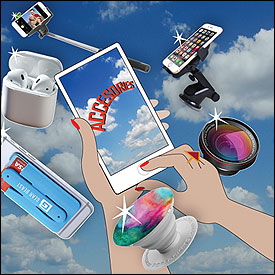
A: By swag, I assume you mean dorky tech toys? If that’s the case, you came to the right place. I’m not going to spend time talking about cell phone bling, because no discerning reader like yourself recognizes value when they see it (ebay.to/2KM6QWw). I’ll let you decide how to dress your fun, and focus on trying to make it a little more fun to use. Some are already available for purchase; some will be the hottest new things.
If you have ever encountered anyone below the age of 30 with a cell phone, then you know their primary goal is: SELFIES!!! Me being less than photogenic, I’m not a huge selfie-taker, but I do know some pretty sweet gear to make selfies a lot more fun to take. Most people are aware of selfie sticks, and there are some good ones out there like this one from Mpow (amzn.to/2ImaoAq), but why not take it to the next level? With the Selfly selfie drone (www.selfly.camera) you can finally get a hands-free shot of you and your fabulous friends.
A more common and compact selfie accessory is the ever popular Popsocket (popsockets.com). They’re compact, cheap, and easy-to-use. They do present a problem for people who mount their phones while driving for GPS use, etc. To solve that problem, they’ve come out with a nice car mount to go along with it, which is equally simple, cheap, and easy-to-use (bit.ly/2jIlQIs).
If you’re a bit more ambitious with your phone photography/videography, there are some nice options out there for you as well. Every generation of cell phone has better and better cameras, but if you want the best quality and versatility in your shots, consider getting some add-on lenses like the ones offered by Amir (bit.ly/2KNBPl8). If you’re the next Scorsese, but don’t have a multimillion dollar budget for your next film, consider an affordable, but high-end gimbal device like this one from DJI (bit.ly/2jFMC4g).
For any communication device, a close second to taking pictures of yourself is, of course, listening to music. With summer upon us, taking your music outdoors is more likely, so you’ll want something with plenty of range and durability to go along with good sound quality. Check out the JBL Waterproof Bluetooth speaker (amzn.to/2I1lCen) – it’s portable, affordable, and will keep the party going with a nice battery life. (You can even use it to charge your phone if your outdoor adventures make outlets scarce).
There are a ton of Bluetooth headphones out there, and while I typically try to recommend things that are made for both Android and Apple devices, the Apple AirPods (apple.com/airpods) are worth the investment if you’re an Apple fan. Their integration with the iPhone, iPad, and Apple Watch, combined with a small, sleek design, are really great. If you’re looking for a nice accessory to help you keep track of them while not in use, Catalyst offers a simple yet attractive waterproof case worth a look (bit.ly/2wpZF31).
Now if you’re not all about fun and games and need something geared more towards productivity, I have something for you as well. Mobile phones are powerful enough these days that with the right app suites, they can largely replace computers for your everyday needs. It can be tough to make that transition without the proper gear though.
Most smart TV’s will allow you to mirror your phone screen on them. If yours doesn’t, Roku (roku.com), Amazon’s Fire stick (amzn.to/2jI15Nk), and Chromecast (goo.gl/gjRcUG) are some inexpensive options that will allow you to do so. That doesn’t cover everything though, so you’ll want to consider adding a nice stand to maintain touchscreen access (amzn.to/2I97onO), and a portable keyboard (amzn.to/2jILYmw) to make inputting info easier.
All of this gear should be more than enough swag for your phone, and run you a lot less that the Louis Vuitton case you were eyeing. You might even have enough cash left over to get a nice thank-you gift for a helpful PropellerHead, eh?